Prison

Prison

Friday, 19 December 2014

Andrew Selous: Not Waving but Drowning

For blog readers who didn’t see it, last night’s interview on the BBC’s Newsnight programme with our part-time Prisons Minister Andrew Selous was a political train crash. It was morbidly fascinating to watch him sink deeper and deeper into the hole that his boss, Chris Grayling, has been busy excavating. Ever the cunning PR wonk, ‘Calamity’ Chris sensibly decided to give Newsnight a miss and tidy his sock drawer, leaving poor hapless Andrew to face the music on national TV where he seemed more like a bewildered rabbit caught in the headlights of an oncoming truck.

Pretty grim viewing for the MOJ
Challenged over the ongoing crisis across the prison estate – chronic staff shortages, rising levels of violence, self-harm and suicide – Mr Selous tripped at every step. Although he was able to spout the figures for the ongoing – and desperate – recruitment drive for new prison officer grades, when asked why the staffing crisis had occurred in the first place, he couldn’t give a straight answer, presumably because honesty would have meant passing the nasty parcel of blame right back to his boss, Mr Grayling.

Even a political heavyweight with much more experience than Mr Selous would have found this interview pretty daunting. The preceding package had included some rather strident critics lining up to have their say, including Frances Crook from the Howard League for Penal Reform, Peter McParlin chairman of the Prison Officers Association (POA) and – myself (the token ex-con). I suppose that between the three of us we have a good few years of first-hand experience of the prison system from our very different perspectives, while poor old Mr Selous has only been in his current post since July – and it showed.

Frances Crook: warnings
Confronted with some pretty uncomfortable figures about the number of prison staff being bussed around the country at taxpayers’ expense in a last ditch effort to plug serious staffing gaps in prisons, he really didn’t have much of an answer about how this fiasco had been permitted to happen in the first place. The real answer, that the Ministry of Justice (MOJ) slashed numbers of frontline staff to reduce the prisons budget without really thinking through the operational consequences, would have been political suicide for any junior minister, so Mr Selous simply tried to deflect the critics by claiming that the continuing rise in prison numbers couldn’t have been foreseen. Really?

The current prison population in England and Wales – 85,755 as of 12 December – is roughly twice the size it was 20 years ago. Each successive government in the meantime has contributed to this rise by introducing harsher sentencing policies, longer sentences (including the disastrous Indeterminate Sentence for Public Protection (IPP)) and increasing the number of new criminal offences and civil orders, many of which now carry potential custodial terms. Add into the mix around 10,000 foreign national prisoners, plus around 10,000 unconvicted prisoners being held on remand (around 75 percent of whom, even if convicted, won’t receive a custodial sentence when they eventually come up in court) and you have the makings of a constantly rising prison population. What part of that could not have been foreseen?

As Mr Grayling did, during his own recent shifty performance in front of the Parliamentary Select Committee on Justice, Mr Selous tried – and failed – to put the blame for the unchecked rise in prisoner numbers on to the late Jimmy Savile and the recent increase in reported ‘historic’ sexual offences. This was received with the journalistic distain it richly deserved, just as the same claim cut no ice with the Justice Committee members either. It’s a red herring and just about everyone knows it, so why Mr Selous felt he had to try it on yet again is anyone’s guess. Sheer desperation?

Mr Selous: out of his depth
The reality is that the MOJ has screwed up pretty monumentally. Older, more expensive-to-maintain prisons have been closed without sufficient new capacity being available. According to the Ministry’s own figures back in March, 77 of the 119 prisons in England and Wales were overcrowded. A little more number crunching and it seems that we have around 10,000 prisoners too many for our current prison establishments to accommodate them “decently”.

Although Mr Grayling has repeatedly claimed that the prison system can cope with anyone given a custodial sentence by a court, the Prison Service has its own internal categories: “certified normal accommodation” and “operational capacity”. According to the MOJ, the former “represents the good, decent standard of accommodation that the Service aspires to provide all prisoners”, while operational capacity means: “the total number of prisoners that an establishment can hold without serious risk to good order, security and the proper running of the planned regime”.
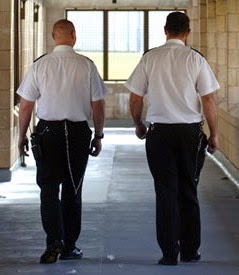
In short supply at the moment
However, with the current total number of prisoners in England and Wales already thousands above the certified levels and now creeping up towards the operational capacity, it is clear that somewhere along the line someone made a pretty spectacular miscalculation. Add to that a substantial reduction in the number of frontline prison staff and you have all the ingredients for an operational meltdown.

The Howard League has calculated – using the MOJ’s own data – that there has been a 41 percent reduction in the total number of operational grade staff since 2010 when there were around 24,000 to 2014 when there are 14,170. It is true that this figure is hotly disputed by the MOJ which claims there are now 27 percent fewer officers than in 2010, but either way, the prison population has increased, the number of certified places is down (due to prison closures) and there are fewer wing staff around – as evidenced by the need to move officers around on what is euphemistically called ‘detached duty’.

This practice, in itself, can have serious implications for security in our prisons. Staff bussed in temporarily from hundreds of miles away won’t know inmates as individuals. There can be no relationship of trust developed and warning signs that trouble may be brewing can be missed. It is, at best, a haphazard – and expensive – way of trying to apply a band-aid solution for what amounts to a very serious mismanagement of a key public service. As usual, the taxpayer will be footing the bill for all of this.

Banged-up
During his interview on Newsnight, Mr Selous really did seem to be completely out of his depth when challenged over the reasons that the current crisis is ongoing. There is still a very unconvincing sense of denial surrounding the marked rise in suicide and self-harm in our prisons, as well as a failure to explain why violent incidents – particularly assaults on staff – are up. Mr Selous’ feeble suggestion that we are now jailing “more violent people” was, frankly, a desperate effort to try to divorce these issues that need to be addressed urgently from the escalating crisis inside prisons that has it roots in poor decision-making by politicians. 

Ministers and officials simply can’t bring themselves to admit that our jails are much less safe and decent places at the moment because of serious mismanagement of the Prison Service by the MOJ’s political leadership. They can’t credibly claim that they weren’t warned. Both the Prison Governors’ Association and the POA – as well as HM Inspectorate of Prisons and the Prison and Probation Ombudsman – have given warning after warning that our prisons are heading for disaster. Juries, it seems, aren’t eager to convict prisoners protesting against deteriorating conditions, including 23-hour bang-up in tiny, overcrowded cells.

Strangeways: the first to riot in 1990
The stage is set for more violence, further suicides and self-harm and, potentially, more serious disturbances and even riots. We may not yet be close to the kind of uprising that occurred across the prison estate back in 1990 when HMP Strangeways went up in smoke over 25 days of violent protest, followed by a number of other prisons across the UK, but many of the same warning signs are present today. Staff morale is close to rock-bottom and with too few frontline officers to effectively control wings – especially in Cat-B and C establishments – if things do kick off, the situation could easily slide out of control, perhaps even more quickly than it did nearly 25 years ago.

If there are prison riots, then Mr Selous – an Old Etonian who seems to have spent much of his career either in the family electronics business or as an insurance underwriter – really won’t be the man capable of sorting it all out. If his performance on Newsnight is anything to go by he’ll be drowning, not waving, when the MOJ Titanic finally hits the iceberg.   

Wednesday, 17 December 2014

Things to do in Segregation

For those who haven’t spent any time inside as a guest of Her Majesty, the segregation unit – otherwise known as ‘the Block’ – is a kind of prison within a prison. Prisoners refer to being ‘down the Block’, although it’s also called ‘the Seg’.

It’s a separate unit inside a prison where cons get sent for extra punishment over and beyond the usual, although a few prisoners do get sent there for their own protection – often if they’ve run up substantial drug debts or are suspected of ‘grassing’ (informing) on other cons. Usually, however, prisoners get sent to Seg as a result of being found guilty of a disciplinary offence, for which they might get 14 days or 28 days in solitary.

Typical seg cell down the Block
Life down the Block can be pretty austere. No rented TV, no personal possessions to speak of. You get to wear dirty old prison kit (usually the oldest, most stained specimens available) and you get a coarse prison towel. Unless it’s actually a ‘strip-cell’ in which case you are kept naked, but with an anti-suicide blanket you can wrap round yourself. 

The bed is either a solid concrete slab with a very thin mattress on it (if you don’t have back pain when you arrive down the Block, you will have by the time you leave), or in the older type of Seg it can be a metal-framed single bunk bolted to the floor. In fact, pretty much everything in the segregation unit is fixed to the wall or the floor in order to prevent irate cons from either throwing anything at staff or trying to barricade themselves in.

Metal bed in Seg
Windows can’t usually be opened, but are fixed units with a small grill to one side that can be opened for fresh air using a knob. However, some of these window mechanisms aren’t working – so either the cold air blows through in winter, or it’s jammed shut in the heat of the summer. Either way, the environment can be pretty grim. After all, what’s the point of having a prison within a prison if it isn’t made even nastier than a normal jail cell?

Although Block cells vary in design, most have some form of table fixed to the floor and wall, a similarly fixed bench to sit on, a stainless steel sink and WC and… that’s about it, folks. Apparently they used to make you roll up the mattress during the day and leave it outside the door to discourage cons from lying on their beds. This practice seems to have stopped (or at least it didn’t happen to me when I was in the Seg).

In theory, you are supposed to be able to request the loan of a radio. However, I’ve never, ever been in a prison where such an item is available. Perhaps those cons who already own one can ask to have it with them. I never had one, so just went without. 

Plastic mug
During my stay in the Block I was allowed the following personal possessions: a cheap wrist watch (mainly because I think the Seg screws forgot to confiscate it), my reading glasses with plastic lenses, one paperback book and a toothbrush (prison issue). I also had the usual plastic prison-issue mug, plate and bowl, plus plastic knife, fork and spoon. Add in a towel, some toothpaste and half a bar of prison soap and that was the lot. Absolutely nothing else other than bedding.

Meals were served on the floor. Literally. You had to stand back from the door as soon as a screw opened it. Then place your empty utensils on the floor by the door. They were then collected by a fellow con who had the enviable job of ‘Seg orderly’ while the two officers on duty watched you like a hawk. Next a tray with food (no choices down the Block other than like it or lump it) and two slices of dry bread was placed in the same place, along with a plastic flask containing hot water – enough to make three mugs of prison tea. When ordered to do so, you stepped forward, bent over and picked these things up, then stepped back. The door was slammed, locked and bolted. 

During the course of the day, three people would invariably come and look in your cell. One was a medic, another was from the chaplaincy team and the third was a governor grade. Occasionally the senior officer responsible for the Block would also check up on you. That was the extent of the human contact permitted.

View from the Block yard
Exercise consisted of being allowed to walk on your own around an entirely enclosed concrete yard with high walls on all four sides topped with rolls of razor wire and what I later discovered were anti-helicopter nets, just in case any of us were sufficiently well-connected to have associates willing to fly over and rescue us, James Bond-style. Every move was monitored by two screws and by CCTV cameras mounted on high poles around the yard.

So what else is there to do in the Seg unit? Well, I was lucky because I was permitted to have a paperback book – actually the Collected Short Stories of US writer John Cheever – so I kept myself going by reading. I deliberately rationed myself to a set number of short stories each day, just in case I ran out. If I had, then there would have been no chance of getting a visit to the prison library to borrow a different book.

John Cheever: short stories
Another activity was to pace out the cell in each direction. My cell was around 8 feet by 10 feet, so I paced it out a couple of hundred times each day. I also did some rudimentary exercises (sit-ups, press-ups etc).    

What struck me most about being down the Block was the almost total lack of human interaction. Prison staff would simply ask “Any complaints?”, although the chaplains usually managed at least to enquire how we were doing. We weren’t allowed to speak to the Seg orderly and although we could hear that there were other prisoners held in the Block, we never actually saw them. Sometimes you did hear cons screaming or shouting, but the screws quickly put a stop to any disturbances. At least it was usually pretty quiet down the Block.

I’m very fortunate that I don’t get claustrophobic. For any con who is, a normal cell must be torture, but a Seg cell must be their very worst nightmare. While I was down there I often heard the alarm sounding because one of my unseen fellow residents had managed to smuggle in a razor blade and cut his wrists, arms or neck. For this reason, razors are forbidden in Block cells. Instead they are issued each morning as you are locked in the shower cubicle and are then collected by the member of staff who also stands and watches as you wash. Self-harm or suicide is always a constant problem in the Seg unit. 

I was lucky in that I only did a week in the Block when I first went into prison. However, I visited most of the Seg units in the prisons I was held in while working as an Insider (peer mentor) or when acting as a ‘McKenzie Friend’ (a lay legal advisor to prisoners facing governor’s adjudications). In the latter cases I used to spend most of a day locked in a Block cell together with my ‘client’ – the con on a disciplinary charge. At least then I had someone to talk to which was a considerable improvement on being in solitary confinement.

It’s well documented that extended periods of isolation have a negative impact on mental and physical health. Some prisoners in UK prisons experience solitary confinement for months or even years resulting in the inevitable deterioration of their minds. 

HMP Bronzefield: criticised by HM Inspectorate
One of the most notorious cases in England was at HMP Bronzefield, a women’s prison in Surrey. HM Inspectorate of Prisons discovered that a female prisoner had spent over five years in the Seg. As Chief Inspector Nick Hardwick observed in his report: “We were dismayed that the woman who had already been in the segregation unit for three years in 2010 was still there in 2013. Her cell was unkempt and squalid and she seldom left it.” He went on to state that “her prolonged location on the segregation unit amounted to cruel, inhumane and degrading treatment − and we use these words advisedly.” 

A few other prisoners have spent 20 years or more in similar conditions down the Block. All pretty shocking in 21st century Britain, especially when the British government is so quick to criticise human rights violations elsewhere in the world. Perhaps we should sort out our own backyard first.

I’m not sure how I would have been able to cope if I had served my entire sentence down the Block. Although I’m pretty strong-minded and haven’t lived with any form of mental illness, I’m certain that extended solitary confinement would have impacted on my personality, perhaps even led me to consider self-harm or suicide. 

However, for those prisoners who are already vulnerable, or suffering from mental health problems, or have addictions, a stint down the Block could prove to be a life or death situation, especially when healthcare resources and staffing are at critical levels in many prisons. In such cases, perhaps the best we can hope for is that they actually survive the experience. Sadly, some don’t.

Monday, 15 December 2014

Did Prison Make Me a Better Person?

In addition to posting on this blog, I also maintain a Twitter account as many readers will be aware. I tweet and retweet about prison issues, the criminal justice system and human rights.

@PrisonUK
Occasionally, I get asked questions via Twitter that are really difficult to answer, especially in 140 characters or less. It seems that not that many people know anyone who has been a prisoner, so they are keen to take an opportunity to find out more about the prison system and the effects incarceration can have on inmates. Even some of those who work in the criminal justice system sometimes ask me for my opinions on subjects that concern them. On occasion, it’s about getting a view from ‘the other side of the cell door’ and I do my best to give honest answers.

Recently I was asked – for the first time – whether I felt that having been in prison had made me a better person. Now that was a very difficult one. I’ll admit that I really had to take some time to think it through before I gave my answer, which was “yes” – although not for the reasons that might have been expected.

In my own case, there are several reasons that I believe prison did make me a better person. The first of those is that I had a chance to re-evaluate my entire life and the direction that my career had been going. I did a fair amount of re-evaluation while I was sitting in a high security cell down the Block (segregation unit), but it that was just the start of a process that has continued for several years. 

Prison toothbrush
I quickly realised that I actually didn’t need all the trappings that a successful career can bring. When the entire range of possessions at your disposal in the Block consists of a cheap wristwatch, a pair of reading glasses, a paperback book and a prison toothbrush, you can suddenly see all the rest in its proper perspective. Strange as it may sound, I am grateful for the opportunity I had to reflect following what amounted to a very radical de-cluttering. Possessions can be nice to have, but very few of them are actually essential.

Another key issue for me is that I rediscovered the skill of listening to other people. I came to realise that this was something I had forgotten during what had been a very intensive period spent getting to the top in my chosen career. Back then I rarely listened to colleagues or to others on my staff. I had become opinionated and was often impatient with other people. I had so little free time that I suppose I’d come to resent spending any of it dealing with other peoples’ concerns and problems.

Relearning the ability to listen
In prison, however, I found that listening to others is not only a very valuable skill, but it can quite literally be a life-saving service for vulnerable fellow cons who are in deep distress. To be honest, I hadn’t really thought about that side of the job when I applied to be an Insider (peer mentor). However, having trained as a counsellor early on in my career, I suddenly found that prisoners wanted to speak to me about their problems and actually valued my advice and support. That, in itself, helped me to regain a sense of balance while I was serving my own prison sentence.

I also had to confront the fact that I hadn’t been a very nice person during the previous few years. Arrogance is never an attractive character trait and learning some real humility – the hard way – in prison certainly didn’t do me any harm. The experience has made me a different person and, I hope, a nicer one.

Being arrogant when you are in the slammer can be a very risky business. Screws hate arrogant cons and some will actively seek ways to put them in their place, whether by ‘nicking’ (charging) them for disciplinary offences, by giving them negative write-ups – putting critical comments on a con’s individual file – or by blocking requests and applications.

Arrogance is dangerous
Being arrogant to fellow cons can be even more dangerous. A perceived insult or slight – often referred to as ‘mugging’ someone off – can lead to violence, particularly when someone has poor anger management skills. In prison, it usually pays to be polite.

So, based on the above, I think it is clear that prison has made me a better person. But did I get rehabilitated? That’s a difficult question, particularly as I still have an appeal against conviction ongoing. However, on balance, my answer would be no, but then I never saw myself as needing to be rehabilitated in the first place.

It’s a funny word, rehabilitation. Not least because it’s one of those odd terms that is regularly used, but very rarely defined. And therein lies the problem. Without a clear definition of any word, it can mean something – or nothing.

It’s also complicated because the term is often used in a medical context, whether the condition being treated is physical or mental. As ‘rehab’ it refers to support to recover from an addiction (something that there isn’t much of inside the nick these days). Then again, in the Soviet Union it meant the quashing of a conviction – often posthumously – of those convicted for political offences during the Stalinist era.

Taken at its most basic level, rehabilitation can be defined as preparation for reintegration back into society of a person who has been convicted of a criminal offence. Of course, they don’t necessarily need to have been sentenced to a custodial term, but it can equally apply to someone who has been given a community penalty, or even a fine.

The whole question of rehabilitation should be central to the whole debate over our prison system. Can imprisonment reform and rehabilitate? Anyone who is a regular reader of this blog will probably know that my personal view is that any real pretence of achieving rehabilitation while cons are inside has been abandoned in recent years, even if it still exists on paper. 

Not much rehabilitation here
During a recent online debate on the subject of deteriorating conditions in our prisons, one of the contributors suggested that deprivation and poor living conditions should be “what prison is all about” because it might deter prisoners from committing further offences and getting sent down again. In my reply I pointed out that if this theory was correct, then there would be far fewer repeat offenders in our jails.

My own view is that treating people inhumanely or brutally has never made anyone a better person. Indeed, given the terrible childhoods that some prisoners have already experienced – including years of physical, mental and often sexual abuse – it seems pretty obvious to me that brutality and violence are often learned behaviours that can have disastrous consequences in later life. The key issue is whether these can be ‘unlearned’, whether in prison or in the community and, if so, how? 

Mistreatment and abuse simply seems to reinforce these undesirable personality traits, particularly when a person already has very low self-esteem. Making daily life inside prisons even more grim, humiliating and miserable than it already is really doesn’t seem to work when it comes to reducing reoffending, as the very high reconviction rates appear to demonstrate. As the rising figures also show this ideological approach of being ‘tough on cons’ also appears to fuel self-harm, violence and suicide.

Kicked out of the gate...
So what does rehabilitation mean for ex-prisoners? I have deliberately avoided using the preferred criminal justice term ‘offender’ here, because I think that rehabilitation should equally apply to those who have been held unconvicted on remand, as well as victims of miscarriages of justice. In my experience, these are two specific groups that are routinely overlooked when it comes to rehabilitation. If a conviction gets quashed by the Court of Appeal, then the former prisoner is just kicked out of the prison gate with absolutely no support or assistance, even if they have already served many years in custody and have become totally institutionalised.

Writing as an ex-prisoner myself, my view is that any support that is offered to assist with the reintegration process will be welcome, both pre-release and when former prisoners are discharged back into the community. Unfortunately, major budget cuts and staff shortages within our prison system mean that resettlement outcomes across the board are often very poor, as recent reports by HM Inspectorate of Prisons have highlighted.

After prison: a struggle to get a job
This also raises the vital, and much more difficult, issue of finding gainful employment when a person has a criminal record. In reality, most of the former prisoners I know who have found legal employment are either self-employed (which requires some initial start-up capital and a range of skills to deal with the paperwork), or else they are working for family, friends or – in a small number of cases – former employers. Obviously the last option is only there for ex-prisoners who had a job prior to being sent down.

However, for a far larger number of ex-cons, there are still massive challenges to face, particularly those who have very limited education or who struggle to read and write; those who are living with mental health problem or who are still struggling with addictions, in some cases fuelled by the easy availability of a wide range of drugs (legal and illegal) inside jails. It’s these much more difficult cases – including those who will leave prison with nothing beyond a £46 grant and no-one to go home to – who will be the challenge to resettle back into the community. In far too many instances, their most likely destination will be back in court and through the ‘revolving door’ of our prisons.

As a society, we just don’t have sufficient support mechanisms in place to address their complex needs, including starting to deal with childhood abuse and all the emotional damage, including self-hatred and the destructive behaviours, that it can cause. Nor will imprisonment have addressed most mental health problems, mainly because these often go undiagnosed because of scarce resources, or dependencies on alcohol or drugs. Some of these ex-prisoners are just so alienated from society that reintegration is probably the last thing on their minds as they step out onto the pavement outside the prison gates - and that is an issue that should concern us all.

Saturday, 13 December 2014

Back Behind Bars… Yet Again!

I was back behind prison walls again yesterday. Hearing those barred metal gates clang shut and keys being turned in locks by men and women dressed in black and white uniforms brought back some mixed memories, as did being given a pretty thorough body search – while still clothed for once – and waiting for doors to be opened. 

A fence within a high wall
As I walked along a concrete path within a very high fence topped with razor wire, that was itself inside the massive grey and intimidating walls of an inner city Cat-B, I had a curious feeling of being back ‘home’ again. That’s institutionalisation in action. The only glimpse of the outside world from inside was the blue sky above and it reminded me of the hundreds of days I’d spent within such confines looking up above the high walls of other prisons that were very similar in layout and design.

At each phase of the journey deeper and deeper into the prison, gates and doors have to be opened by a member of staff. The spaces and rooms steadily get smaller and more enclosed as you enter each new section.

Inside, it was all fluorescent lighting and all-too familiar polished lino tile floors. You can smell the same brand of disinfectant masking the stench of unwashed men on every prison wing. On the notice boards, there were the same old posters about reporting bullying and warnings against smuggling contraband. Everywhere CCTV cameras follow your every move, controlled from the security office. Home, sweet home! 

Black and white uniforms
Fortunately, I was just making another social visit to a good friend who is back inside on recall. I knew that at the end of the afternoon I’d be going back out into the real world, while he wouldn’t. In fact, he has no idea when, or if, he’ll be getting released. Such is the inhumanity of the now discontinued Indeterminate Sentence for Public Protection (IPP) although thousands of prisoners are still serving it with no end in sight.

If any reader feels the urge to experience a tiny little bit of what it’s like to be locked up in a UK prison – without actually committing a crime or being the victim of a miscarriage of justice – then I’d recommend going on a prison visit if you ever get the chance. Believe me, when the first barred metal gate clangs shut and you realise that you are on the wrong side of it without any keys, you do start to get the sense of being caged and confined that prison is all about. 

Most of my fellow visitors were old hands at the game. Like me, they knew exactly what the routines were, including the order in which the body searches are carried out. You don’t even have to be asked to open your mouth, lift your arms, spread your legs or raise your feet so your soles can be checked. The security staff are mainly on the look out for drugs, but prepaid mobile phone SIM cards are also very easy to conceal and can help keep major drug dealers inside the nick in contact with their networks back on the street.

Body search ahead of a visit
To be fair, it’s all done in a very businesslike and professional manner, but the searching is quite a lot more intrusive than you’d normally experience at an airport (unless you get taken away into one of the little backrooms, of course). Having a complete stranger running their hands over your body and putting their fingers in your pockets is just one of the compulsory procedures before a visitor is permitted any contact with inmates.

A few of the younger lads going in at the same time as me had probably been inside themselves as they seemed to know some members of staff by name. I guessed that they were also visiting family or perhaps mates they’d got to know when they were serving time inside the slammer. I know that a surprising number of ex-cons remain in touch with lads they have met in jail, sometimes helping out by sending in a bit of cash to their prison accounts and coming in on visiting days to help keep morale up.

It’s good to see friends face to face, even if you do speak regularly on the phone or write. We chat about our legal cases, exchange news about mutual acquaintances and I get an update on the deepening crisis inside the prison where there has been a recent suicide and major cutbacks in staffing. The 90-minute session seems to pass in a flash and it’s soon time to end the visit. 

A visits hall in a UK prison
Leaving the prison at the end of a session in the visits hall is a much quicker affair. At this particular private sector nick they make use of electronic fingerprint scanners and it seems that almost every door and gate is open before you even get to it. Getting inside takes the best part of an hour. Going out again can be as quick as five minutes.

Beyond the enjoyment of seeing good friends who I want to support while they are inside, I sometimes feel that I also need to make these visits in order to plug myself back into what is really happening inside our prisons on a daily basis. Of course, I also receive regular letters from mates who are still serving their sentences, as well as information from family members, but there is no substitute for actually going back inside from time to time. 

Early next year I’m planning to visit another friend who is serving a very long sentence in one of Britain’s very worst Cat-B nicks. I hope to find out for myself just how bad the situation there has become since I did some time there myself a couple of years ago. It was an absolute disgrace back then, so with even less staff and much greater overcrowding on the wings, I want to hear for myself how things really are from a lad who is living through it all day, every day, year after year.  

Friday, 12 December 2014

On the Wrong Side of the Door

One of the most common phrases that anyone who is a serving prisoner hears on a daily basis is “Behind your doors!”. It’s an order from a member of staff to go back to your cell and close your own door, locking yourself in – effectively becoming your own compliant gaoler. 

Behind your doors!
Since there isn’t a handle on the inside of the cell door, once the bolt is sprung, it can only be opened from the outside. After you’ve ‘banged up’ (closed your door), a screw will come along the landing checking that the door is locked and opening the viewing flap to peer through into the cell to ensure that the right number of cons are present and correct for the roll.

There is something very final about the sound that the heavy lock makes as it seals you into your pad (cell). Once you’ve heard it, whether in a police cell or in the nick, you’ll never forget it. 

The clunk made when you shut a cell door is a very different sound to the other common noise inside a prison and that is the loud clang when barred metal gates are shut by members of staff. These gates are at the end of every wing in a closed prison, as well as dividing various walkways and sections. Crossing from one side of a jail to another can involve frequent stops and starts as cons have to wait for each gate to be unlocked and then relocked by staff.

Keys are a potent symbol in prisons, as well as a stark reminder of the vast gulf between those who have them (the screws and other staff) and those who don’t (the cons). Even civilian staff wear leather belts with keys and chains (a security measure to guard against cons grabbing them).

The power of the keys
Today, I was reflecting on just how powerless a prisoner in a closed nick is simply because he or she is the one who doesn’t have a bunch of keys – or the freedom of movement they provide. They are, quite literally, on the wrong side of the door.

This evening there is one extra con on a wing of some Cat-B local, possibly down in the induction wing, or even lying on his bunk in a Vulnerable Prisoner Unit (VPU) reflecting on how roles have been reversed. This prisoner, Scott Chapman, used to be a prison officer. Now, like all the other cons in whichever nick he is in tonight, he is essentially a number. While all staff and prisoners do have ID cards, they are very different and now he has the ‘wrong’ type hanging on a bootlace round his neck – and he is on the wrong side of the door.

Mr Chapman, who has just been sent down on a sentence of three and a half ‘sheets’ (years) has been found guilty of selling stories about a prisoner who was in his care to the now defunct News of the World tabloid newspaper. In this case, the tittle-tattle was about Jon Venables, one of the two kids who killed little James Bulger back in 1993. On their own, the stories seem not to have had much meat to them, just bits of information about what was perceived to have been special treatment that Mr Venables (now known by another name) was supposed to be receiving when he was recalled to prison in 2010.

The late, unlamented News of the Screws
Although Mr Chapman claimed in court that he felt these stories were in the public interest, the fact that he’d pocketed a cool £40,000 from various tabloids including the News of the World, The Sun, The Sunday Mirror and The Daily Star did tend to undermine his attempt to justify his conduct. He was accordingly convicted by a jury last month of conspiracy to commit misconduct in public office and sentenced this week. A former News of the World hack received a six-month suspended prison sentence in respect of the same offence.

I’ve posted previously on this blog about how stories get leaked – often for cash – from inside prisons: Telling Tales out of Jail. Sometimes the culprits are fellow cons, but screws and civilian prison staff occasionally get prosecuted for selling stories about famous or notorious prisoners. Now Mr Chapman is paying the price for his activities.

All prisoners are potentially vulnerable to this sort of information leaking, although it’s obviously the well-known or infamous who are most liable to have confidential details about themselves plastered over the tabloids. The practice is particularly harmful because it can severely undermine what very limited trust exists between uniformed staff and cons. Which prisoners would ever talk to their wing officers about personal problems if they suspected that such sensitive discussions could be sold for cash and published? Jails are rich breeding grounds for paranoia and activities such as those Mr Chapman profited from simply fuel this distrust.

Paranoia thrives behind bars
Now he has been sent down I doubt that he will get any sympathy or favours from his former colleagues in the Prison Service. During the trial, the head of security at the National Offender Management Service (NOMS), Adrian Scott, explained in evidence how leaking confidential information about prisoners risked creating “security and order issues” inside prisons. 

Although for his own safety Mr Chapman won’t be sent to any establishment where he formerly served as an officer, his situation for the next 21 months (unless he qualifies for early release on Home Detention Curfew or ‘tag’) isn’t likely to be enviable. As his barrister pleaded in mitigation during sentencing, he fears being scalded with boiling water and sugar (‘jugging’, as it is usually called), or being slashed with prison-issue razors melted into plastic brush handles (‘striping’). This evidently didn’t carry much weight with the judge, Mr Justice Wide, as he imposed a pretty stiff prison sentence.

Prison-made 'shanks'
Having met a couple of disgraced former screws when I was in a Cat-D (open) prison, I actually think that it’s unlikely Mr Chapman will get either ‘jugged’ or ‘striped’. While he’s in closed conditions, he’ll almost certainly serve his sentence on a VPU with other vulnerable prisoners, including sex offenders, former police officers, dead-beat drug debtors and cons suspected of being ‘grasses’ (informers). I doubt there will be much congenial company for a former screw, but if he has any sense he’ll keep his head down and avoid getting into any trouble. This may mean that he has to spend 23 hours banged up on the wrong side of his door, but such is life.

I suppose that he will also find his former colleagues less than supportive. If there’s one thing that most prison officers despise more than ordinary cons, it’s a bent screw who has been sent down. This sort of thing gives the uniform a bad name. They also won’t want to be seen doing him any favours or cutting him slack, so he’ll have to get used to hearing the word “no” when making requests. No doubt he’ll find all this a deeply humiliating and humbling experience.

No favours from staff
I’m sure he will be only too conscious of the complete role reversal. He’ll now be on the receiving end of procedures that no doubt he oversaw himself in his previous career. Like any other con he’ll be ordered to strip, wear grubby, ill-fitting prison clothing and to get behind his door. He’ll be body searched regularly and, above all, he will feel utterly powerless. He’s joined the ranks of those who are on the wrong side of the door and who don’t have a bunch of those all-important keys. 

Reflecting on Mr Chapman’s current situation, I’m reminded of a verse from the appropriately titled song This is Hell by Elvis Costello:  

It’s not the torment of the flames
That finally sees your flesh corrupted
It's the small humiliations that your memory piles up.

And I suspect that he will experience those “small humiliations” pretty much every single day of his sentence, at least until he finally gets to an open prison where things might be a bit more relaxed. As he is lying in his bunk tonight, I imagine he’s feeling very scared and very much alone. Every prisoner has been there, but he will be in a very special circle of hell and it is of his own making.

Perhaps I shouldn’t, but I must admit that I do find myself feeling a bit sorry for him, as one human being to another. If he does get to share a cell, I hope he’ll find it’s with someone who will offer him a bit of support. Who knows, perhaps he’ll discover that there are some very decent people in prison who are willing to extend the hand of friendship – even to a disgraced screw who finds himself on the wrong side of the cell door.